
Slurry tank roofing.
We cover slurry tanks with an outside diameter of 5 to 41 m using a heavy-duty curtain on a stainless steel structure. The roofing reduces emissions of ammonia and odour gases and at the same time keeps rainwater out of the tank. We carry out the expert assessment, the structural calculation and the installation ourselves.
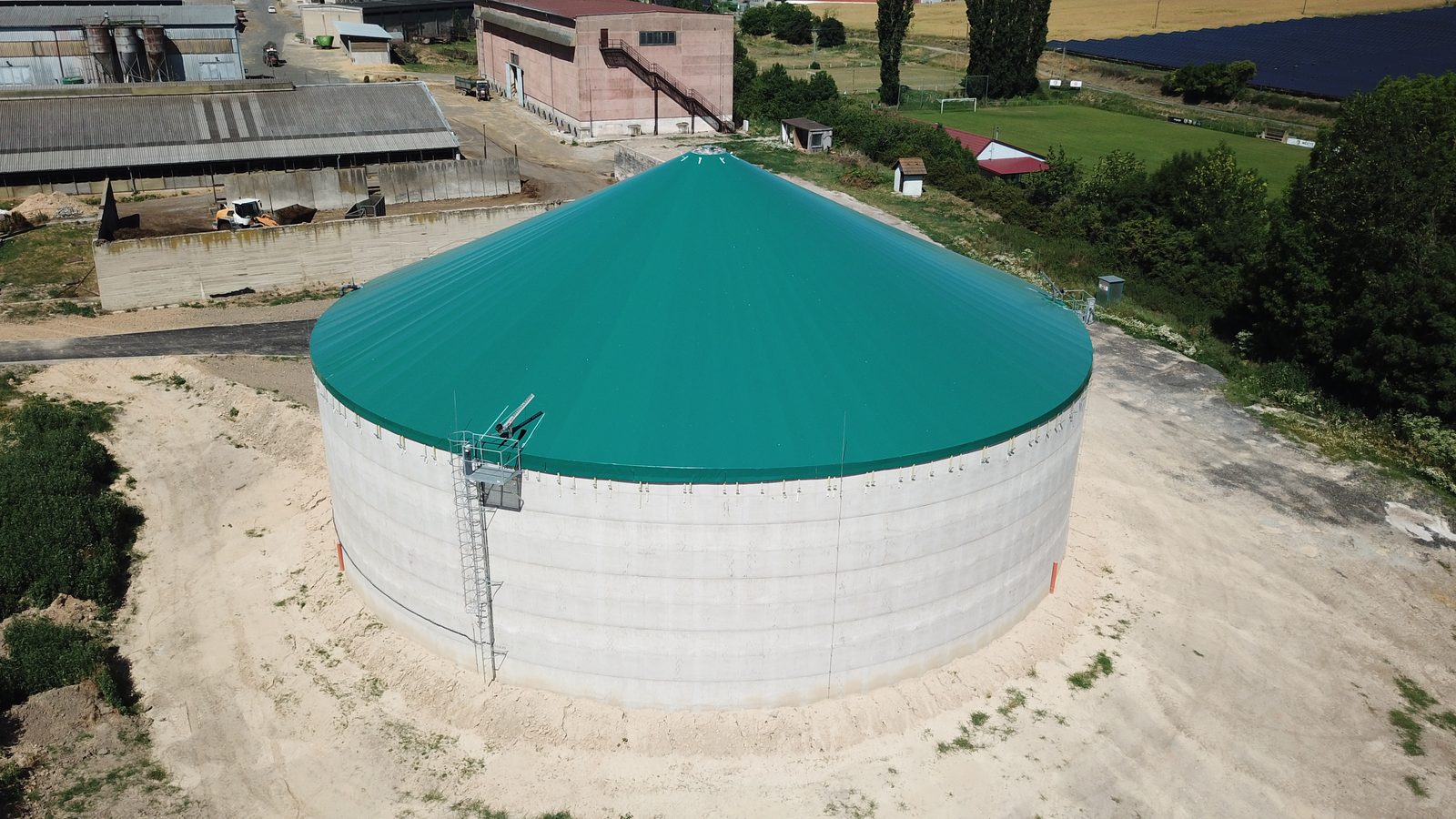
How the roofing is built.
Tensioning ratchets are fitted around the perimeter of the concrete tank. Our stainless steel column is chemically anchored in the centre; a stainless steel ring sits on it, and the straps are then anchored to that ring. The structure is tensioned by a heavy-duty curtain with a weight of 900-1050 g/m², according to the customer's wishes and needs. The whole load-bearing structure is made of stainless steel, which extends the service life of the system.
What the roofing delivers.
Covering the tank significantly reduces ammonia emissions and the spread of odorous substances into the surrounding area. On sites where odour is a problem for neighbouring buildings, this is a proven solution with a marked benefit.
- Lower emissionsAmmonia and odour.The curtain reduces the escape of ammonia and odour gases from the tank into the air.
- No rainwaterSmaller volume.The roofing keeps rainwater out of the tank, so it does not dilute the contents or increase the volume to be hauled away.
- Assessment and structural designFor every tank.We carry out the expert assessment on site and supply the structural calculation.
- Subsidy supportExtra scoring points.In past subsidy schemes, slurry tank roofing was awarded extra points in the scoring and could therefore improve the chances of obtaining subsidy support.
Fill in the form and we will get back to you by the next working day.
What you ask most often.
How large a slurry tank can you roof?
We cover slurry tanks with an outside diameter of 5 to 41 m. We design the specific solution after an expert assessment on site.
What are the curtain and structure made of?
The curtain is heavy-duty, with a weight of 900-1050 g/m² according to the customer's wishes. The load-bearing structure - tensioning ratchets, the central stainless steel ring and the straps - is made of stainless steel, so it withstands the livestock building environment and has a long service life.
Does the roofing help with emissions?
Yes. Covering the slurry tank reduces the escape of ammonia and odour gases from the surface into the air and at the same time keeps rainwater out of the tank.
Do you carry out the structural calculation?
Yes. For every slurry tank we carry out an expert assessment on site and supply the structural calculation. Our team then handles the complete installation.
Can an existing concrete slurry tank be roofed as well?
Yes. We chemically anchor a stainless steel column in the centre of the slurry tank, with a stainless steel ring sitting on it, and we fit tensioning ratchets around the perimeter. We assess the suitability of the particular tank on site.